
What the Humantay lake offers us:
- Driving distance from Cusco: (77 Miles /124 KM)
- Driving time: 3 hours one-way. Approx. 6 hours in total.
- Entrance fee: S/ 10 / $ 3.00
- Base elevation: (12,700 ft. / 3850 masl.)
- Difficulty: Moderately – difficult hike.
- Trail: Sand gravel road at the beginning, flat for about 30 minutes. Then the climb has rocks all over the way.
- Hiking Distance: (4.5 ML / 7 KM round trip)
- Horse rentals: At the beginning of the hike for $ 21 / s/. 80 (one way)
- Walking time: 1H 30M to get to the lake. And 01H for coming back.
- Top elevation: (13,800 ft. / 4200 masl.)
- Duration of the complete day: 12 – 13 hours.
- Elevation difference during trek: (1312 ft. / 400 m)
What is the Humantay lake?
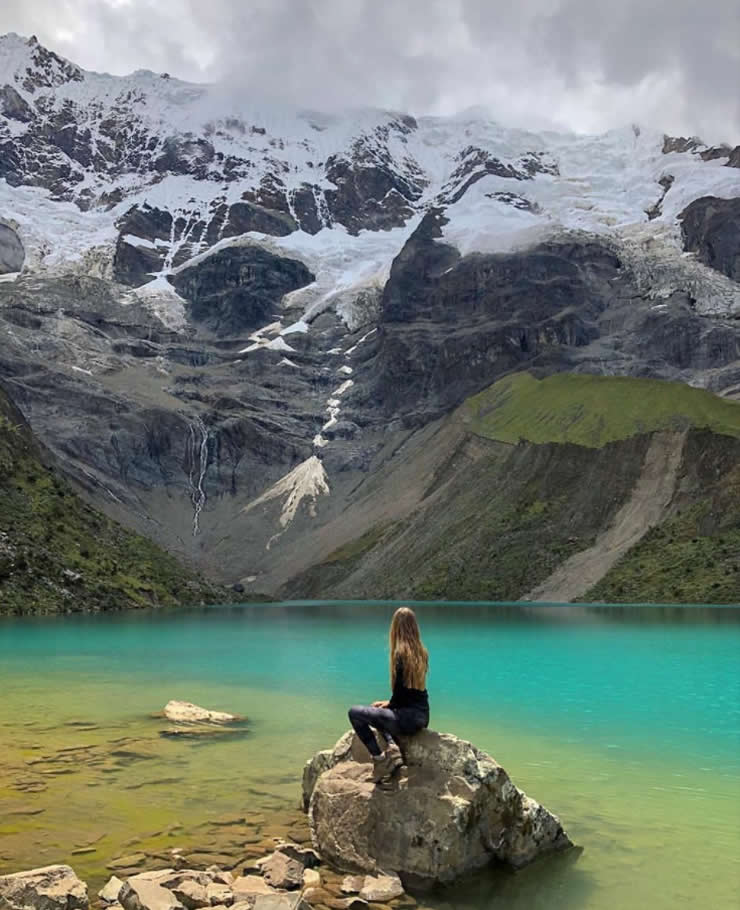
Humantay Lake is a relatively small lake, but what makes this body of water so popular is that on a good sunny day everyone can see the turquoise at its best. It has a 100% glacial origin.
Where is Humantay lake located?
It is located at 77 Miles / 124 km northwest of Cusco, in the Mollepata district, Anta province, Cusco region.
Why is the Humantay lake turquoise?
One of the widely accepted reasons for the turquoise coloration is the presence of mineral flours or dust carried by the icy waters. Those tiny mineral flours never sink at the bottom of the lake. Moreover, the presence of microalgae (Microcystis aeruginosa and Oscillatoria), plus the sunlight, reflect the beautiful turquoise color.
Is Humantay worth it?
The photos of the Humantay lake speak for themselves, and yes, it is worth it. If possible, climb up the lookout on the left bank to walk around and you won’t regret it. The views from above the valley are stunning.
Preparation for the altitude sickness
Do not underestimate proper acclimatization; stay in Cusco for at least a couple of days. Altitude sickness can affect anybody. For most travelers, it is nothing more than a headache and a dizzy sensation that diminishes over one to two days.
You can face it by drinking coca tea, which is widely popular amongst locals and available in almost every hotel in Cusco. If you are short on time, talk to your doctor about medication.
When is the best time for Humantay lake Peru hike?
The dry season (May until early October) is the best time to avoid rain and see the turquoise color at its best. However, Humantay Lake can be visited year-round, with fewer people during the rainy season.
How is the Humantay lake weather?
During the dry season, it is very cold in the morning. In the rainy season, the climate is warmer and the path muddier. Average weather in Cusco ranges from 32 °F / 0°C to 68 °F / 20 °C.
Are there restrooms along the trail?
Restrooms are at the beginning of the hike and another spot within 30 minutes. Use costs S/ 1.00; make sure to carry your own tissue. There are no restrooms near the lake itself.
The overlook of the Salkantay and Humantay mountains
From the Soraypampa campsite, you get a glimpse of Salkantay Mountain (20,580 ft / 6273 masl) rising behind Humantay Mountain (17,500 ft / 5,334 masl). On sunny days, both display a spectacle of grandeur.
Muleteers along the trail
Mules are essential for high elevations and are used in the Salkantay trek to Machu Picchu. You will see them at Soraypampa camp carrying supplies or equipment for hikers.
Humantay lake a preferred tourism destination and how it began
When the Inca Trail became overcrowded, guides began traversing the Salkantay pass. As the Salkantay Trek became a popular alternative to Machu Picchu, visitors discovered Humantay Lake nearby, and it soon flooded social media.

How the Humantay lake formed?
As glaciers retreated less than 20,000 years ago, ice carved the land leaving moraines. Melting water from the Humantay Mountain filled the depression, originating the lake that bears the mountain’s name.
Is there any danger on the hiking path?
The path is easy to follow, but watch your step for rocks or slippery areas. Also, stand aside when mules pass to avoid kicks. Avalanches occur up in the peaks but rarely reach the valley.
How is cell phone service there?
There is no cell signal or wireless internet. In emergencies, you can sometimes buy a few minutes of Wi-Fi from a grocery store at the base camp.
Useful information
- The earlier you leave Cusco, the better, to arrive before the crowds.
- Humantay Lake is the third most visited place after Machu Picchu and Rainbow Mountain.
- Entering the water is strictly prohibited.
- Health first: if you feel dizzy or nauseous, descend immediately.
- Soraypampa houses campgrounds with geodesic dome tents for stargazing.
What to pack for the Humantay lake day trip?
It is essential to be well prepared for high altitude. Pack these items:
- A down and rain jacket.
- A pair of gloves.
- A hoodie/hat and sunglasses.
- Hiking shoes.
- Rain poncho.
- Hiking poles.
- Water bottle and snacks.
- Sunscreen and camera.
- Cash for restrooms or horse rentals.

My name is Abel, and I am the co-founder of AB Expeditions, a local travel company based in Cusco. I was born in Chinchero, in the community of Chusso. My journey began working as a farmer, then later as a porter on the Inca Trail. After that, I studied to become a tour guide, learned English, and spent 20 years guiding different treks around the Cusco region.
Over the years, I began writing blogs about the treks I’ve done and sharing useful tips about traveling in Cusco. Eventually, I founded AB Expeditions to offer authentic travel experiences with a strong commitment to supporting local communities and creating unforgettable adventures for our guests.
- Abel

- Abel
- Abel
- Abel
